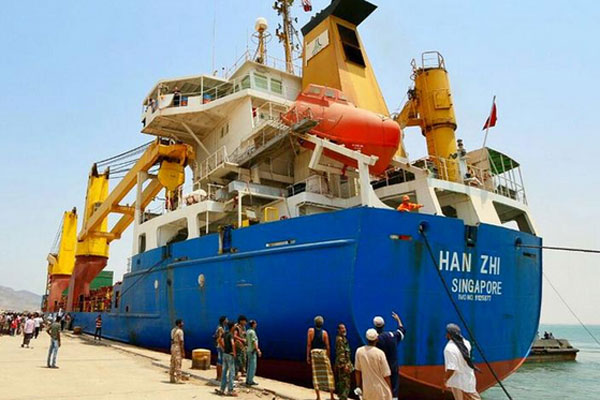
Ahlul Bayt News Agency - Residents in the Yemeni capital Sanaa are stocking up on rare food and fuel supplies after the notorious ex-president in exile decided to divert aid ships from the Houthi and popular committees-held north to loyalist areas farther south.
Sources in Yemen's government confirmed the move, though there has been no official announcement, and Yemen's exiled information minister said on Tuesday that commercial flights would be diverted from the capital to the southern port of Aden.
The decisions come as southern fighters backed by weapons and air strikes by neighbouring Gulf states have made some gains on southern battlefields against the Houthis backed by popular committees.
A Saudi-led alliance (Egypt, Morocco, Jordan, Sudan, Kuwait, the United Arab Emirates, Qatar, Bahrain) has been bombing Yemen's civil areas since March in support of the country's exiled leadership, which now seeks to reestablish its base from Aden.
"Gas stations have closed, and there are fears that the coalition will impose a siege on Sanaa and the cities of the north. We're afraid," said Ali Saleh, who was searching for ways to fill up his taxi.
"Everybody's afraid of the possibility that fighting will break out in Sanaa, and we ask God to protect us," he said.
Residents in the capital scrambled to stock up on food from stores as the black market price for 20 litres of petrol jumped to 60 dollars in recent days compared to an official price of 15 dollars.
Ali al-Ahmadi, a spokesman for the anti-Houthi forces, claimed the Houthis were ejected from all of the key province of Lahej on Wednesday, bringing the number of southern provinces under anti-Houthi control to three.
Early on Thursday, the Saudi-led coalition said a ground forces soldier by the name of Yahya Miteb Shamri died after he was hit by a projectile in Saudi Arabia's Jizan province, which shares a border with Yemen. The nationality of the soldier was not identified.
Early on Wednesday, at least six civilians lost their lives and two others sustained injuries when Saudi jets fired a missile into a residential building in the Hawd al-Ashraf district of Yemen’s southwestern province of Ta’izz. Local residents said five of the victims were members of one family.
On March 26, Saudi Arabia began its military aggression against Yemen – without a UN mandate – in a bid to undermine the Houthi Ansarullah movement and to restore power to Hadi, an ally of Riyadh.
Tarik Jasarevic, a spokesman for the World Health Organization, said on July 28 that 1,859 civilians were among the total of 3,984 people killed in Yemen until July 19. Local Yemeni sources, however, put the fatality figure at a much higher number.
/129